
Building the Future Healthcare Workforce: Mankato’s Central High School Students Complete CNA Career Pathways Program

This year, ten students from Central High School (CHS), Mankato’s high school for students whose needs haven’t been met by traditional education, got a chance to jumpstart their healthcare careers – completely free – through Project Success’ CNA (Certified Nursing Assistant) Career Pathways Program.
Led by Dr. Elia Dimayuga-Bruggeman, Senior Education Advisor at Project Success, this Career Pathways Program provided CHS students with five months of training that could change their futures. For young people who have faced challenges in their education, this program offered something concrete: a clear path to a stable, in-demand career, and a stepping-stone toward further education in healthcare.
Thanks to funding from Catalyse Loolanka iyo Greater Twin Cities United Way, and in partnership with Mankato Area Public Schools, Central High School, South Central College, and Oak Terrace Assisted Living Facility, this program was designed specifically to meet students where they are – removing barriers and creating real opportunities.
Real Training, Real Impact
From January to May, students in the program met weekly at South Central College for classes, hands-on labs, and clinical training. Of the ten students who started, seven completed all components of the program: the coursework, the Minnesota CNA licensing exam, and summer internships at Oak Terrace Assisted Living Facility. One graduating senior even started working as a full-time CNA at a residential living facility after their internship ended.
For many students, working with residents made all the difference. One student shared, “My favorite part was the clinicals where we went into the nursing home and worked with real people. This helped me realize that to you it might not seem like a big deal, but your help is important for their wellbeing.”
That hands-on connection where students spent time supporting residents with daily living tasks, taking vital signs, communicating with residents’ families, ensuring resident’s comfort and safety, and practicing basic medical assistance brought classroom learning to life.
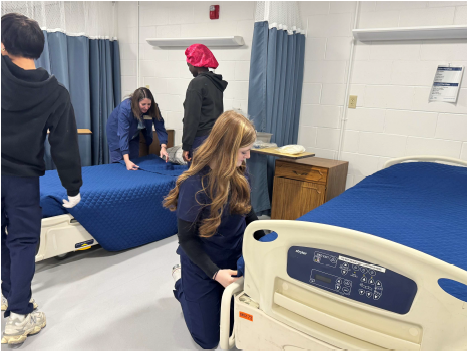
Student Adeck appreciated both the practical benefits and the doors the program opened: “I enjoyed taking this [CNA] course because of the endless opportunities it has given me. Not only am I being offered an internship to continue my hands-on learning, but my course was fully paid for. I believe becoming a CNA is a great first step for those interested in stepping into the medical field.”
Breaking Down Barriers
This first-of-its-kind program at Central High School (CHS) was designed to prepare students with essential caregiving skills while helping fill Minnesota’s critical need for a more diverse healthcare workforce.
Students who participated received:
- Dual high school and college credit
- Training for the Minnesota Nursing Assistant/Home Health Aide exam
- 110 hours of classroom instruction plus 16 hours of hands-on lab training
- A guaranteed internship at Oak Terrace Assisted Living Facility
- Stipends for completing program milestones
- All costs covered —scrubs, kits, background checks, exam fees, transportation, meals, and college registration support
- Dedicated mentoring and support from Dr. Bruggeman and school administration

Students completed the program with essential skills in patient care, safety and infection control, record keeping, and communication—creating a direct pipeline to employment and a strong foundation for future careers as LPNs, RNs, or other healthcare professionals and giving them the immediate certification to work as a CNA.
The Impact
For students at an alternative high school, a program like this is more than job training—it is proof that their path forward doesn’t have to look like everyone else’s. Many CHS students have faced educational, social, or vocational challenges that have made traditional schooling difficult. The CNA Career Pathways Program met them exactly where they were and gave them the structure, support, and skills to succeed.

Beyond offering students this opportunity, it addressed a critical need in Minnesota – healthcare facilities throughout the state are struggling to maintain staffing. As Drew Hood, Administrator from Oak Terrace points out, “Nursing homes in Minnesota are shutting down…staffing is one of the main reasons.” He adds that “we have a workforce crisis coming up in general, specifically for long-term care, because we are not going to be able to automate our way out of needing caregivers.”
Programs like this aren’t just good for students – they’re essential for communities. With the need for culturally responsive healthcare workers continuing to grow, the CNA Career Pathways Program from Project Success removed barriers for students, created opportunities of excellence for them, and ensured that they had portable career skills they could take with them beyond high school graduation.
Dr. Bruggeman explains, “Project Success’ career-connected programs really sets the students up for better futures, and for really going into something that they want to do.” She emphasizes that “pathways into career-connected learning for students in healthcare is just an excellent way that we are going to be sustaining them not just the career, but also a good wage for living in the future.”